

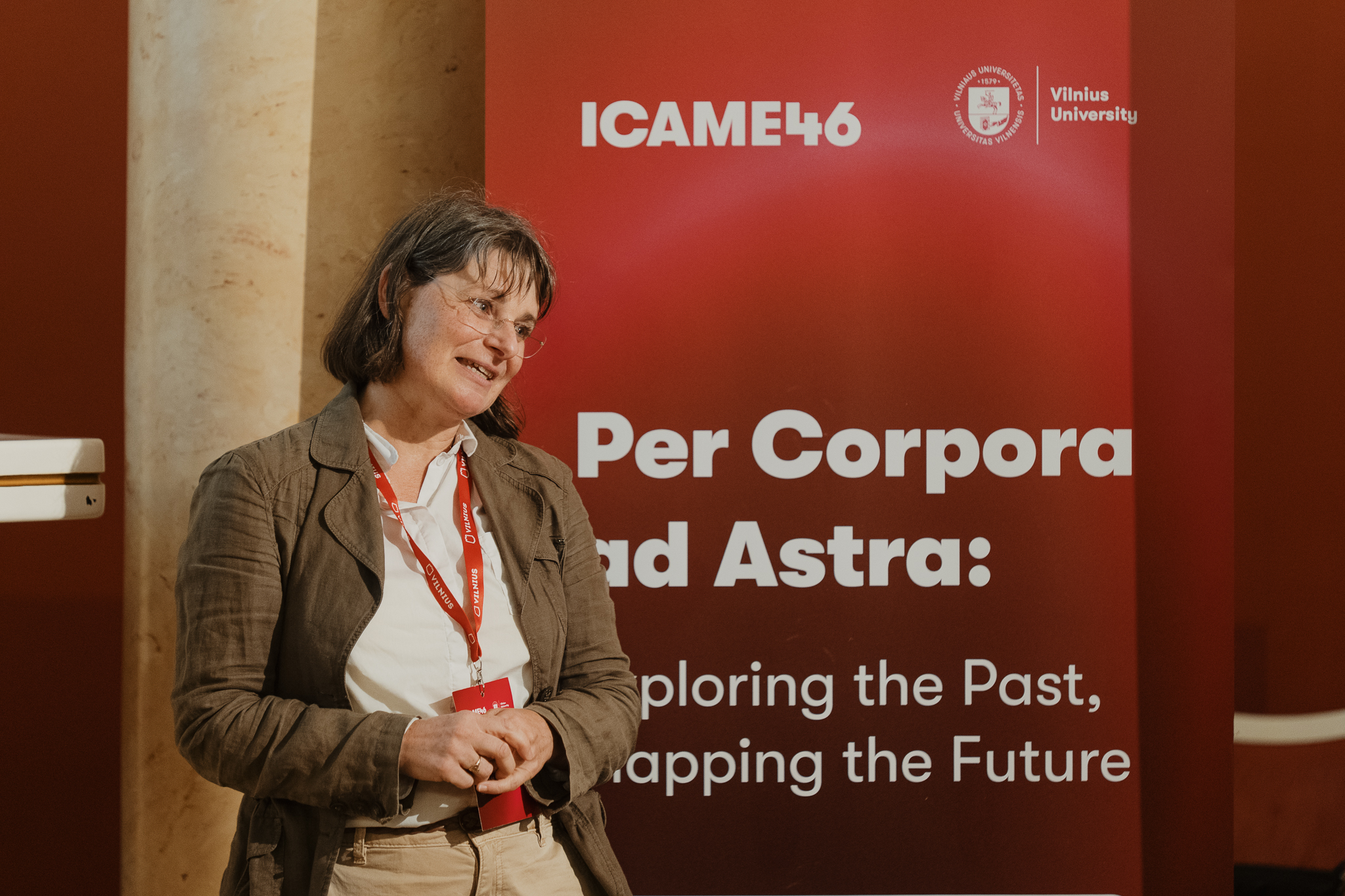
Prof Dr Patricia Ronan / Vilnius university / Ugnius Bagdonavičius photo
Patricia Ronan (Chair of the ICAME Board) interviewed by Jolanta Šinkūnienė (Institute of English, Romance and Classical Studies).
Jolanta Šinkūnienė. Last week the Faculty of Philology of Vilnius University hosted the 46th Annual International ICAME (International Computer Archive of Modern and Medieval English) conference. From June 17 to 21, the Old Campus of Vilnius University was filled with inspiring discussions about synchronic and diachronic studies of English, new software for linguistic research, statistical methods and many other aspects of corpus linguistics. We are probably correct to assume that ICAME is the first and the oldest association of corpus linguists, as it has continued to thrive for 46 years. In your opinion, which factors could have contributed to such success?
Patricia Ronan. Yes, to the best of my knowledge that is indeed the case. ICAME - the International Computer Archive of Modern and Medieval English - is a conference series which is steered by a Board which decides on the locations of the annual conferences and awards bursaries and prizes.
I think there are various reasons for the success of the conference series: a conference-internal reason is that there has always been a very strong community spirit amongst the ICAMERs, the traditionally friendly spirit at the conference, a focus on a balance of not only topics but also diversity of background of presenters are important for us. Also, the annual boat-trip – a sine qua non of the conference – and the conference dinner with a near-obligatory disco, support this community feeling. Early career researchers should feel as welcome as seasoned linguists, and everyone benefits from the exchange.
J. Š. As the Chair of the ICAME Board, how do you see the development of ICAME over these past 46 years? Were there any significant turning points? Was the development of linguistic research consistently going hand in hand with technological advancement in the world?
P. R. I would say we have seen a gradual, but at the same time incredible rise of computing and computing power, which made it possible to analyse increasingly large data sets and obtain more powerful results. This means that corpus linguistics is an increasingly more powerful method for getting answers to more and more questions researchers may have. Clear turning points are the rise of web2.0, when users could start generate their own content on the web and the amount of freely and easily available, international linguistic data increased in an unprecedented way. We now have the languages of the world at our fingertips. A second turning point we have been seeing during the last two years is that the rise of large language models like ChatGPT allow researchers blended approaches that increase the power of our queries.
J. Š. The theme of ICAME46 was “Per Corpora ad Astra: Exploring the Past, Mapping the Future”. I think we have covered most of the past, but what about the future? Where is corpus linguistics going in light of the recent advancements of AI?
P. R. The arrival of AI is indeed a very important development for corpus linguistics. We are already seeing that some corpus tools, like AntConc, are integrating AI support tools to make corpus research easier and more accessible. The downside is, as was shown in the first plenary at ICAME46 this year, that we have to be careful to continue analyzing human language and not end up with analyzing linguistic data that was not created by humans, but by a statistics-based model.
J. Š. What role do you think the Vilnius ICAME46 conference may play in the development of corpus linguistics? Does the thematic focus of the talks presented at the conference point to some specific linguistic trends that are shaping up at this moment?
P. R. I think it was very valuable that you had a focus on the use of AI: the field of linguistics in general and corpus linguistics in particular, like any scientific and educational field, needs to determine how to integrate AI most efficiently and in an ethical way. A further important direction was the investigation of how to use language in commercial discourses, including in funding applications. This research strand has so far not received enough attention and everyone in academia knows about the high importance of using our linguistic tools most efficiently to be successful in these areas.
J. Š. One of the trending topics in the contemporary international research landscape is the role of multidisciplinarity, interdisciplinarity and transdisciplinarity in addressing complex societal challenges. Corpus linguistics has been interdisciplinary from the very beginning, with computer scientists working alongside linguists. At the start of ICAME, the disciplinary divide perhaps was much more visible than it is now. Do you see research of ICAME members integrating into some other disciplines and other science fields?
P. R. With the arrival of larger corpora, the use of quantitative and statistical approaches has become more and more important. We are expanding into quantitative directions more, and we are also integrating more knowledge on how to create useful tools for corpus research. In addition to this, it would be good if we could raise awareness of how useful corpus linguistic approaches are beyond linguistics - for the humanities in general, but also for social sciences and even for natural sciences, to which they can offer powerful tools and approaches for data and thus knowledge management.
J. Š. ICAME members have traditionally focused mainly on English corpora. With the development of emphasis on the importance of other languages in research to foster diversity and inclusion, what is your prediction regarding the scope of languages studied in future ICAME conferences?
P. R. ICAME has traditionally had a strong research strand on contrastive linguistics. There have been contrastive workshops at ICAME conferences for years and they are still very attractive, drawing many papers and large audiences. With its explicit focus on the linguistics of English, I do not see ICAME moving into the analysis of a single other language than English, but the contrastive strand will stay strong.
J. Š. And now a personal question. For you and for many ICAME participants this was the first visit to Vilnius. How did you find the city? Has the “unexpectedly amazing” Vilnius, as called by the city’s official tourism and business development agency “Go Vilnius”, lived up to your expectations?
P. R. Vilnius has captured my heart. It is a beautiful city with amazing people. I do not think that “unexpectedly amazing” should stay the way to advertise the city. Given all that Vilnius has to offer, everyone should totally expect to be amazed by the city.
J. Š. Finally, could you share a few words or wishes for Vilnius University and its community?
P. R. The delegates at ICAME46 and the ICAME Board, and I personally, too, were very impressed with the excellent organisation of the conference. We were welcomed at the university by the Pro-Rector for Partnerships, the Dean of the Faculty of Philology and many extremely committed organizers and helpers. We have experienced not only a very welcoming and very efficient university community, but also a very energetic and innovative institution, with which many scholars will wish to strengthen their ties.
J. Š. Thank you for an interesting conversation!