

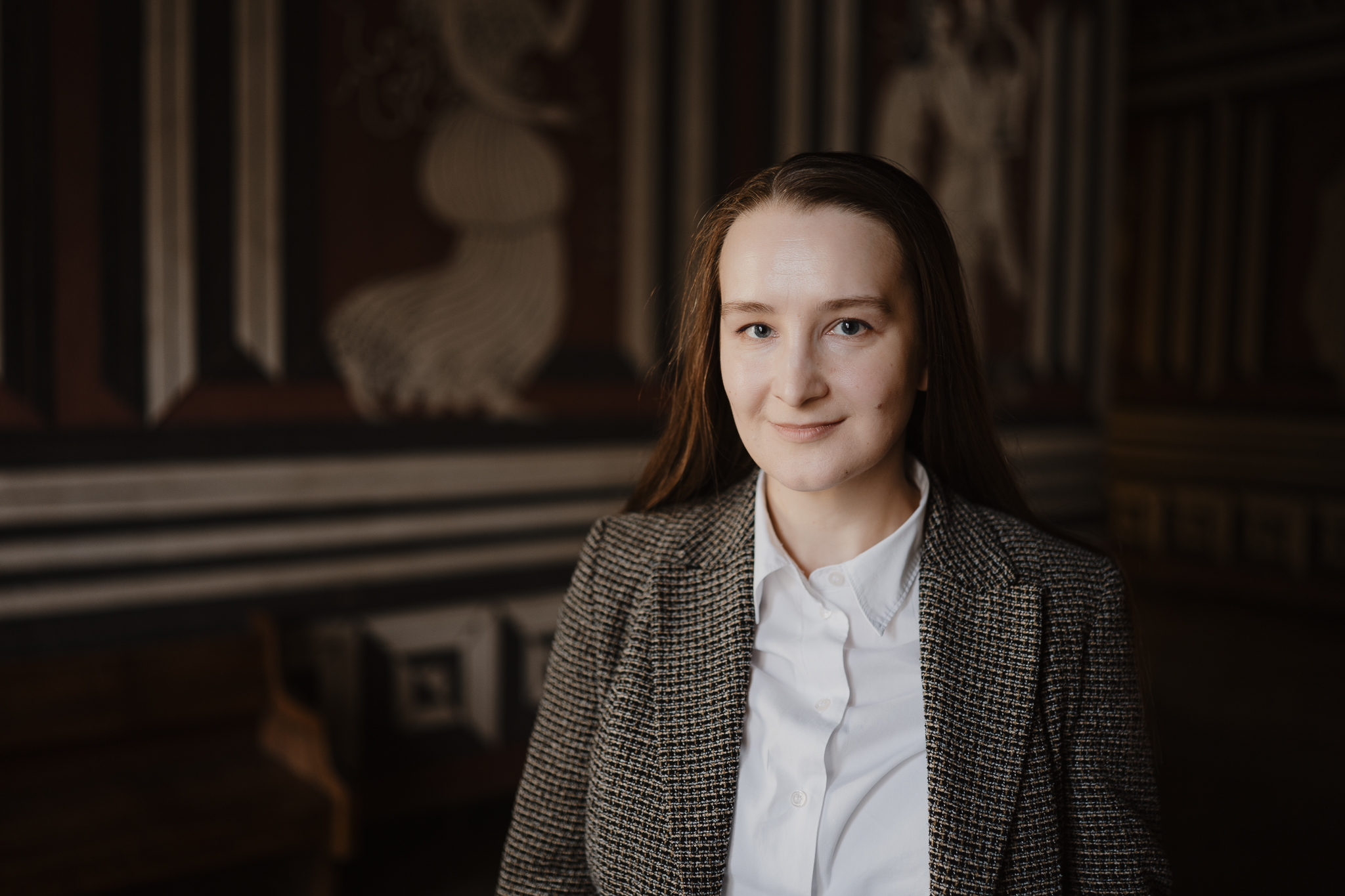
Vilnius University / Ugnius Bagdonavičius photo
Originally from Kaunas District, Dr Aistė Čelkytė’s love of reading and fascination with Antiquity led her to several prestigious universities around the world. After two decades of academic work abroad, the scholar says she had always hoped to eventually work in Lithuania. Now teaching at the Faculty of Philology of Vilnius University (VU), Dr Čelkytė is delighted by the strong classical philology tradition and the active academic community she feels at the University. She says that it is precisely here that she sees many opportunities for growth. We asked her how she discovered Antiquity, how her studies abroad enriched her, and what knowledge and experience she brought back to Lithuania.
Fascinated by Antiquity since childhood
Growing up in Panevėžiukas (Kaunas District) and completing her basic schooling there, Dr Aistė Čelkytė had plenty of time to read in the quiet settlement, and as she herself says, in her childhood she read “everything that caught my eye.” Although she enjoyed everything as a pupil, when she received Jean-Pierre Vernant’s The Universe, the Gods, and Men: Interpretations of Myths as a gift, she realised that Antiquity and classical philology were what interested her most.
“I was deeply drawn to the precise analysis and, at that time, even astonishing insights of this legendary scholar into the seemingly well-known ancient Greek myths,” the lecturer recalls.
Although a deeper study of Antiquity is only possible with knowledge of Greek or Latin, at that time schools offered no opportunity to learn these languages. Dr Čelkytė says that the ability to learn languages, instilled in her by her English teacher Evelina Jaleniauskienė at Panevėžiukas Basic School, proved very useful later on. When she began studying Ancient World History at Durham University (United Kingdom), she was not daunted either by lectures in English or by learning Greek and Latin.
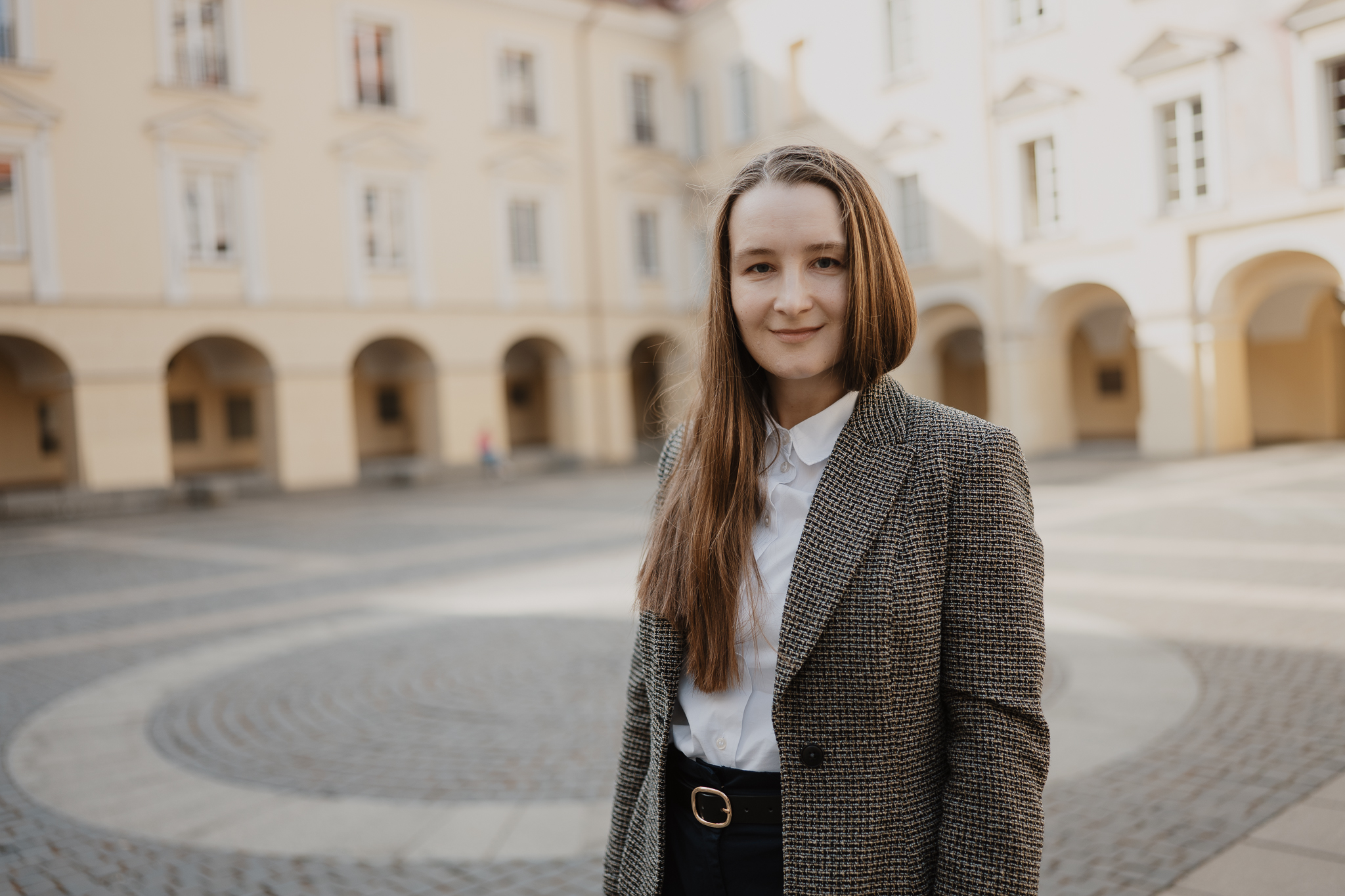
Vilnius University / Ugnius Bagdonavičius photo
Soon she became interested in the philosophers of Antiquity as well. While attending a lecture on early Greek philosophers at Durham University, the young student was captivated by the surviving fragments of ancient thinkers’ works preserved only in excerpts. At first, they intrigued her with their strangeness, and later with their complexity. For instance, one fragment by Thales declares that everything in the world is water.
“I was very intrigued by the fact that such fragments can be ‘decoded,’ revealing attempts to explain natural phenomena – in this case, natural change,” says Dr Čelkytė.
It was precisely this “decoding” of ancient thought, reminiscent of detective work, that fascinated and deeply engaged her. To this day, her academic research often revolves around fragmented sources and lesser-known figures of Antiquity.
The Stoic Concept of Beauty
Later, at the prestigious University of St Andrews in Scotland – one of the world’s leading centres for the study of ancient philosophy – the scholar successfully defended her dissertation on the Stoic concept of beauty. Based on this research, a monograph was later published by an Edinburgh press. When asked how the Stoics understood beauty, Dr Čelkytė explains that the Stoic conception of beauty consists of two parts. The first is proportionality (Greek: summetria).
“Proportionality was perhaps the most important concept in Greek art as early as the fifth century BC, after the sculptor Polykleitos discovered which proportions made sculptures appear most beautiful. The Stoics, like many other philosophers, first define beauty as proportionality,” the scholar notes.
“The second part of their concept of beauty is the functional aspect of beauty: beauty is not an abstract proportionality, but proportionality appropriate to the function of a thing or a person,” she explains.
Such an understanding of beauty was not only innovative but also particularly fitting for philosophers concerned with ethics and the beauty of the soul. “According to the Stoics, the most beautiful people are the sages, because their completely harmonious and proportionate beliefs mean that they are entirely rational – and being rational is the nature and function of human beings,” the scholar remarks with admiration.
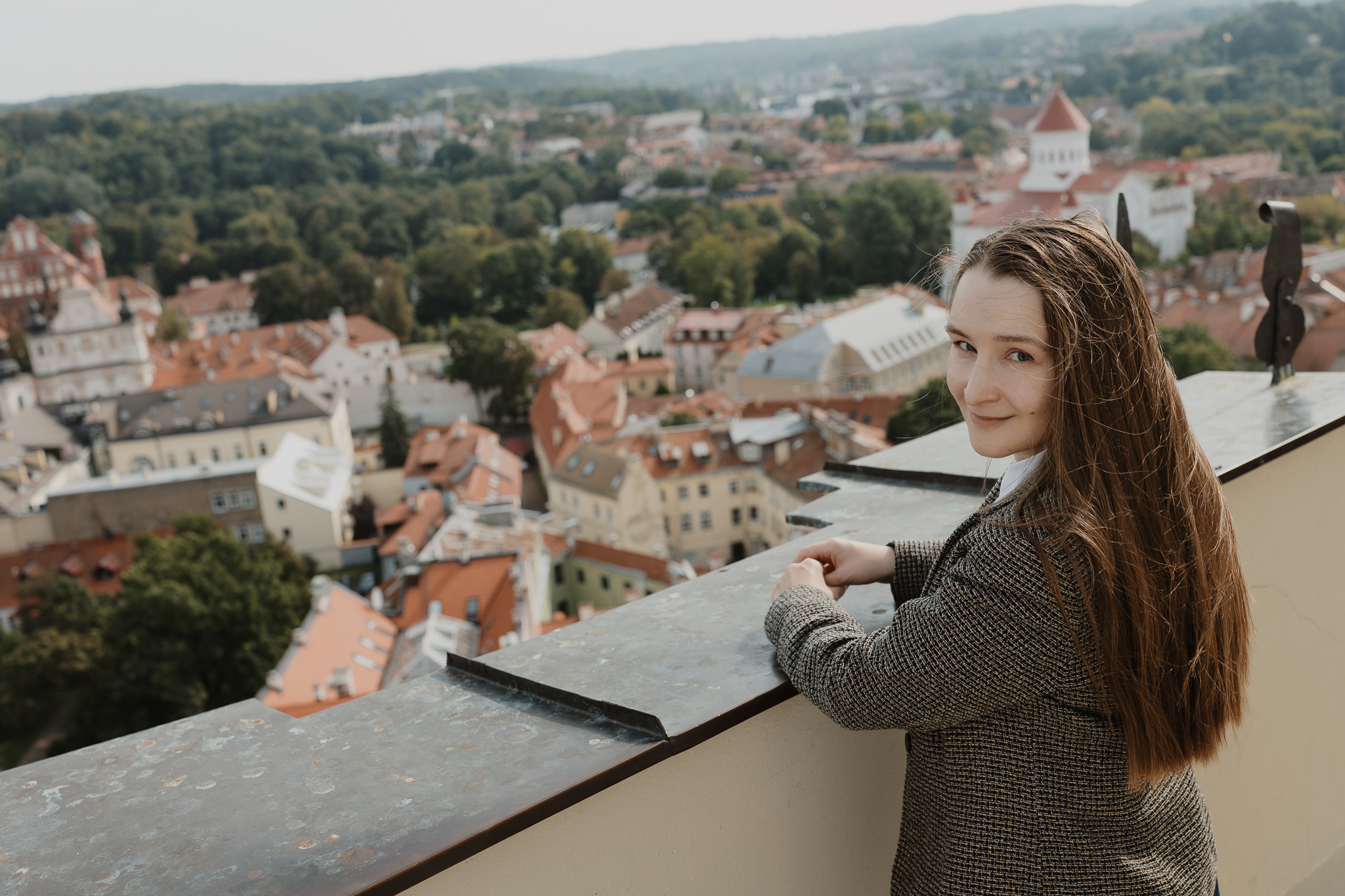
Vilnius University / Ugnius Bagdonavičius photo
Incidentally, the cover of Dr Aistė Čelkytė’s monograph features Mikalojus Konstantinas Čiurlionis’s Sonata of the Stars. The lecturer says she sees many connections to philosophy in Čiurlionis’s work, as it explores numerous thought-provoking themes – for instance, world creation and divinity. According to Dr Čelkytė, the Stoics would appreciate not only the aesthetic value of Čiurlionis’s paintings and music but also their philosophical dimensions.
Dr Čelkytė has completed postdoctoral research projects in South Korea and the Netherlands, and her research topics are remarkably diverse: ancient biology, medicine, cosmology, and economic theory. Recently, her second book was published – on the Roman physician Galen and his conception of the body.
When asked why it is still relevant today to study the natural sciences of Antiquity – whose knowledge might seem outdated – she insists: “Nothing has made me appreciate modern science, especially medicine, more than studying ancient science.” At the same time, she adds that she would not recommend ancient medicine to those who wish to learn how to heal. “If you are interested in questions about the nature of science, its methodology, and how scientific progress happens – or doesn’t happen – there is no better source than the history of science.”
Moreover, she notes, not everything in ancient science is obsolete. A question that remains highly relevant today – whether physicians should base their diagnoses and treatments on the latest research and statistics or on personal experience – was already at the centre of debates among ancient rationalists and empiricists. “The former relied on theoretical conceptions of the body, while the latter claimed that only the doctor’s own experience is a truly reliable way to help patients,” the researcher explains.
Back to Lithuania
Although Dr Čelkytė says she did not have any concrete plans to return to Lithuania, she always hoped that she would eventually work here. So, when the opportunity to teach in Vilnius arose, she immediately seized it.
“Vilnius University is especially appealing for its very old and impressive tradition of classical philology, as well as its truly sizeable community of classicists, many of whom are very active colleagues. Here I see many opportunities to grow and develop as a scholar and lecturer,” says the researcher, who sees her future in Lithuania.
Asked whether twenty years of experience abroad changed her perception of her homeland, she replies that Lithuanians often place very high demands both on themselves and on Lithuania. In her view, although this is not bad in principle, high expectations also bring negative comparisons and overly critical evaluations, which are not always justified.
On the other hand, she acknowledges that while there are areas where she would like to see more progress, she now understands much better that “the occupation left many wounds that are still healing – and healing takes time.”
Having been rediscovering Lithuania since September, the researcher and lecturer at Vilnius University’s Faculty of Philology says she especially values her students’ curiosity and creativity. In her teaching, she prioritises active learning methods and promises her students plenty of discussions. She will be giving lectures on conceptions of the body in Antiquity for bachelor’s students, and on women in the Greek intellectual tradition for master’s students. The lecturer hopes that some of them will become so engaged with these topics that they will be inspired to undertake translations. “It would be wonderful if more texts – for example, those of Hippocrates – were available in Lithuanian,” she shares.