Sidebar

1_copy_copy_copy_copy_copy_copy_copy_copy_copy_copy_copy_copy_copy.jpg

Vilnius university / Ugnius Bagdonavičius photo

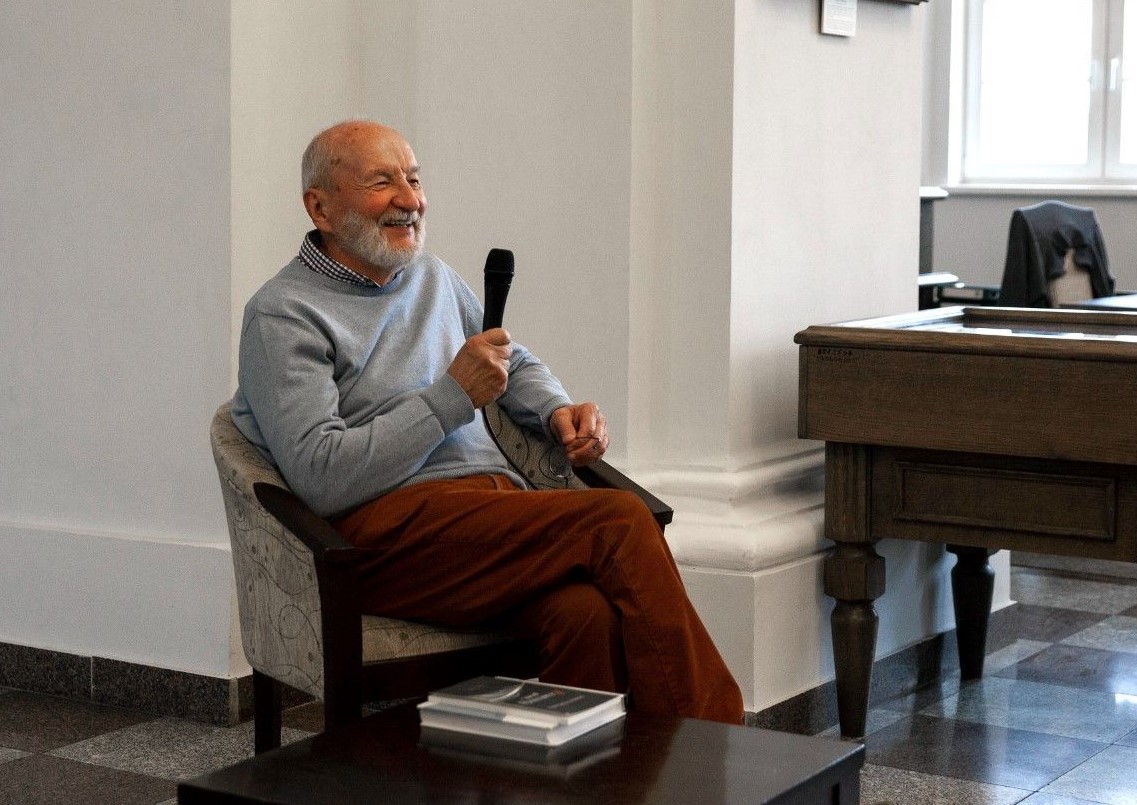
Dr Luca Gili, researcher and author of two books and nearly 50 articles published in various prestigious journals, started his postdoctoral fellowship at Vilnius University (VU) in May 2024. Dr. Gili a researcher in medieval and ancient logic and metaphysics focuses on the history of logic and Aristotle's philosophy. He received his PhD from the University of Leuven in Belgium and has worked at the University of Quebec in Montreal.

Although he knew Lithuania primarily as his wife's home country, the Italian scholar believes that through the guidance of the Head of the Department of Classical Studies, Assoc. Prof. Vilius Bartninkas, he has discovered a very vibrant academic environment here, where he wants to be for intellectual pleasure and a competitive academic environment. He is interviewed by Laisvūnas Čekavičius, a PhD student at the VU Faculty of Philology.

You studied in Pisa, Italy, and Leuven, Belgium. What attracted you to classics and philosophy?

What a difficult question! In high school, I chose a classical curriculum, which includes an introduction to ancient Greek, Latin, ancient literature, and philosophy. I don't remember exactly why I chose this option, but in my time it was common for good students to choose the classical curriculum, the so-called liceo classico [Italian liceo classico is a type of secondary school in Italy where it is compulsory to study Ancient Greek and Latin languages and literature]. Maybe things have changed in the last 20 years, but I think classic is still one of the best ways of teaching in Italy. When I was in high school, I realised that I really liked Greek literature and philosophy.

I wasn't quite sure what I was going to do at university but I got a scholarship from the Scuola Normale at the University of Pisa, which covered food and tuition fees, so I opted for the humanities without thinking much about what I was going to do next. If I hadn't received the scholarship, I probably would have chosen studies that would have given me a more stable job, like medicine. While I was studying at the Scuola Normale, I hadn't yet decided whether I wanted to study Classics or Philosophy - two different undergraduate programmes at the University of Pisa. I was fascinated by Francesco Del Punta's lectures on medieval philosophy, so I started studying philosophy. However, Del Punta noticed my talent for reading Greek texts and persuaded me to study Alexander Aphrodisias, of whom I had not yet heard, and to write a master's thesis on this great commentator on Aristotle.

What attracted me to classics and philosophy? I love the fact that the Greeks, especially Plato and Aristotle, pursue truth and wisdom in such a straightforward way. Their ideas seduced me from the very beginning and continue to amaze me to this day. I also ended up in Leuven by chance. I started my doctoral studies in Padua, Italy, under the supervision of a. a. Riccardo Quinto. Unfortunately, Riccardo fell ill with a rare disease and died soon after, and the University of Leuven offered me a generous scholarship, so it seemed wise to abandon the Italian programme and stay only in Leuven. There I worked on medieval philosophy under the supervision of Russ Friedman and joined a large group of young PhD students and post-docs specialising in ancient and medieval philosophy.

You have previously taught in Montreal, Canada, and now you teach in Chieti, Italy. What are the differences between Classical Studies in these countries?

An honest answer to this question is probably not very politically correct. The working conditions in Montreal are much better than in Italy in terms of salaries and, I would say, the freedom to do research without a lot of bureaucratic hassle. Although Italy in general is a bureaucratic nightmare, it is particularly difficult to navigate in the small areas of southern Italy. This may sound stereotypical, but it is true. You may wonder why I left Canada for Italy. The answer is that one does not live by bread alone, so I was happy to take the opportunity to return with my family to my native hills. Both universities (UQÀM in Montreal, Canada, and Chieti in Italy) have quite a diverse student body, mostly from socially disadvantaged backgrounds, which is very important to me, because the students at these institutions although they probably did not go to the best schools, are eager to learn and eager to learn, and it is a real pleasure to talk to them about the philosophy of antiquity.

Which ancient text has most shaped your personality?

It is difficult to answer. When I was perhaps 13 years old, I read the 19th-century Italian poet Giacomo Leopardi's book 'Operette morali' ('Small Moral Works'). At that time, I liked Leopardi's poems very much and it seemed natural to turn to his 'philosophical' work, which I do not regard so favourably today. Leopardi was in love with antiquity, but it was probably only thanks to him that I understood the greatness of Dante, another important Italian poet. I remember reading an edition of Dante that belonged to my mother, which did not contain 'Paradise'. The editor of the edition was the Marxist literary critic Natalino Sapegno, who had a habit of explaining Dante's poems with long quotations from Aquinas. I discovered philosophy in these footnotes and have loved it ever since. So, in a way, Dante's Inferno has had the greatest impact on me.

As far as my moral theory is concerned, I have always been an Aristotelian, even before I read Aristotle's Nicomachean Ethics, so I would dare to say that Aristotle did not shape me in this respect, because in his pages I found what I already believed. I have not changed in one respect since I was thirteen: I still enjoy reading Leopardi's 'Alla sua Donna', a hymn to the ideal woman with a strong Platonic flavour: she is 'one of the eternal ideas'.

You wrote your dissertation on Thomas Aquinas' natural philosophy and have recently published a book 'Aquinas on Change and Time'. How would you describe the relationship between ancient and medieval philosophy - do you see continuities or rather differences?

You really like difficult questions! I discovered Aristotle through Aquinas, Aquinas through Dante, so in terms of order of discovery, medieval and ancient philosophers are closely related. My university studies confirmed this initial impression because F. Del Punta liked to give in-depth lectures on Aristotle's texts - it usually took us a whole academic year to get through three or four chapters, i.e. 2–4 pages of Bekker in total. Then we read all the commentators on Aristotle's texts, whether in late antiquity, medieval Arabic or medieval Latin. This in-depth approach also allowed me to see the differences between Aristotle and his commentators, but in my understanding, these great minds are in constant dialogue with each other.

How would you describe the main task and thesis of your book?

In my book 'Aquinas on Change and Time', I set three goals. First, to show that Aquinas thought it was possible to describe change (motus) coherently and that change is identical to a changing thing in the present. Second, to show that Aquinas was a consistent presentist who did not allow for the existence of time parts in the past or future. Finally, to show that time, according to Aquinas, exists independently of the mind and should be understood as a disposition of a changing thing, which must be understood as such by a capable mind.

What do you think are the most relevant contemporary research topics in relation to Aristotle's philosophy?

I think Aristotle himself has an answer to this: at the beginning of Book VII of the 'Metaphysics', he says that in the past, as in his own time, people have tried to answer the question of what is 'being', i.e. what is 'substance'. In my opinion, this is still a topical issue, although it is not as popular as it was in the 1990s, in the early 2000s, when the commentary on 'Metaphysics' Z by M. Frédé and G. Patzig appeared. If we talk about academic fads, I would say that it is now very popular to study how Aristotle practised science and how he argued a philosophical question, and people are particularly interested in the dialectical models of argumentation he adopted.

What research brought you to Lithuania and what are you trying to discover here?

A few years ago, a woman asked me on the Oude Markt in Leuven which coffee I liked better - 'Lavazza' or 'Illy'. Apparently, I answered correctly, so a few years later we got married and had children. She is Lithuanian and, thanks to her, I have been discovering every corner of this beautiful country for many years. We got married in the beautiful St Anne's Church in the centre of Vilnius.

2_copy_copy_copy_copy_copy_copy_copy_copy_copy_copy_copy_copy.jpg

Vilnius university / Ugnius Bagdonavičius photo

It was only about a year ago, when I was in Vilnius, that I met the head of the Department of Classical Studies, Vilius Bartninkas, and thanks to him I discovered a very lively academic environment. I immediately wanted to be part of it - for the intellectual pleasure I could get from talking to my colleagues, for the challenge of being in a competitive academic environment again, and also because I was considering spending more time in Lithuania with my family, as my older children are attending school in Lithuania so that they could get to know my mother's mother tongue better. I sometimes think that if I had said that I liked 'Lavazza' better that night in the Oude Markt, life would have been very different.

BaroCon_2025_copy_copy.png

In 2025, we will commemorate the 400th anniversary of the first publication of Matheus Casimirus Sarbievius' most famous Latin poetry collection 'Lyricorum libri tres' (1625). This has led to 2025 being declared the Year of Baroque Literature in Lithuania. The eminent Jesuit neo-Latin poet of the Polish-Lithuanian Commonwealth, Sarbievius, has been hailed as the Christian Horace and the Sarmatian Horace. His theoretical thoughts on poetry and rhetoric are still highly regarded and have inspired new research on other concurrent themes and authors. This anniversary provides an opportunity to explore the extent and diversity of Baroque literary culture, which has seen a surge of interest in recent decades, both in the academic world and in popular culture. Therefore, the Institute of Lithuanian Literature and Folklore, together with the Faculty of Philology of Vilnius University, is organising an international academic conference "Ratio, affectus, sensus: Literary Culture of the Baroque in the Grand Duchy of Lithuania" on 25-27 September 2025 in the baroque city of Vilnius.

The aim of the multidisciplinary conference is to stimulate discussion on the literary culture of the "long seventeenth century" (from the end of the 16th century to the middle of the 18th century) in the Grand Duchy of Lithuania. This historical period, associated with dramatic changes and a general cultural crisis, is often described in contradictory terms and in constant tension between reason and senses, rigid structure and passions, classifications and impressions, etc. By embracing this contradiction, we invite an exploration of the theme in question through the lens of this dynamic interplay between reason (ratio), emotion (affectus) and the senses (sensus), which can be perceived in various genres of the period, such as poetry, biography, hagiography, rhetoric, private and public correspondence, and so on. The importance of the modern approach lies not only in what it can reveal about the Baroque in the Grand Duchy of Lithuania, but also about subsequent and contemporary literary culture, as scholars have demonstrated the continuing influence of a 'Baroque spirit'.

More information about the event at the link below:

BaroCon 2025

Root_Cause_CUT_copy.png

On 14th November 10 am an international scientific conference 'Root Cause: Comparative Studies in Literature and Translation' will take place in Vilnius, Lithuania, as part of the '2024: the Year of Estonian Literature in Lithuania' programme. The confirmed keynote speakers are dr. Aija Sakova (Ene Mihkelson Society, Tallinn University) and dr. Elle-Mari Talivee (Under and Tuglas Literature Centre of the Estonian Academy of Sciences, Tallinn University). Conference participants are the following Estonian, Lithuanian and Czech literary scholars, grad and PhD students and translators: Eva Velsker, Mart Velsker, Ene-Reet Soovik, Jan-Marek Šík, Daina Valentinavičienė, Johanna Roos, Kateřina Běláková, Markas Aurelijus Piesinas. 

Conference venue: Vilnius UNESCO City of Literature (šv. Jono g. 11–16).

Registration: 9:45 am.

Conference starts at 10 am.

You may find the full programme, keynotes and abstracts attached below. 

More information:

If you have any questions regarding the conference, please contact us at .

Welcome to the conference and see you soon!

 53574801426 d833f31b61 z

From 28 to 29 October, we invite all eligible academic staff members to cast their votes for candidates running for the Council of Vilnius University (VU) at the designated polling stations. Early voting takes place on 21–22 October. To check your eligibility, simply enter your full name on the dedicated election subpage (the entry field is at the bottom of the text, under the prompt to check your eligibility “Patikrinkite, ar turite teisę rinkti Tarybą. Sužinokite, kur ir kada”). We also kindly encourage you to participate in the candidate debates, where you can learn more about their ideas and proposals to help you make an informed voting decision.

The election of the VU Council is organised in accordance with the Description of the Procedure for the Election and Termination of the Powers of the Members of the Council of Vilnius University approved by the Senate of Vilnius University and Resolution of the Senate of Vilnius University No. SPN-34 of 21 May 2024 “On the Initiation of the Election of the Council of Vilnius University”. For the most up-to-date information on the candidates, see the VU Council Elections 2024 subpage; the latest information on the debates can be found on the Debates subpage (available in Lithuanian).

Voting will take place at designated locations within the following VU units. Please refer to the list below to find out where you can cast your vote in the election of the VU Council.

Faculty of Chemistry and Geosciences

Early voting

21–22 October

from 10:00 to 16:00

Institute of Chemistry, Room 224

Naugarduko g. 24, Vilnius

Council election

(first round)
28 October

from 10:00 to 16:00

Institute of Geosciences,
Room 312

M. K. Čiurlionio g. 21, Vilnius

29 October

from 10:00 to 16:00

Institute of Chemistry, Room 224

Naugarduko g. 24, Vilnius

Faculty of Economics and Business Administration

(voting will occur simultaneously with the electors from the Business School)

Early voting
21–22 October

from 10:00 to 16:00

Faculty of Economics and Business Administration,

Room 417

Saulėtekio al. 9, Vilnius

Council election

(first round)

28–29 October

from 10:00 to 16:00

Faculty of Economics and Business Administration,

Room 417

Saulėtekio al. 9, Vilnius

Faculty of Philology

Early voting
21–22 October

from 10:30 to 16:00

Institute of Foreign Languages,

German language classroom

Universiteto g. 5, Vilnius

Council election

(first round)

28–29 October

from 10:30 to 16:00

Institute of Foreign Languages,

German language classroom

Universiteto g. 5, Vilnius

Faculty of Philosophy

Early voting
21–22 October

from 10:00 to 16:00

Dean’s Office,

Room 212

Universiteto g. 3, Vilnius

Council election

(first round)

28–29 October

from 10:00 to 16:00

Department of Continental Philosophy and Religious Studies, Room 106

Universiteto g. 3, Vilnius

Faculty of Physics

Early voting
21 October

from 9:00 to 11:00 and from 15:30 to 17:00

Room 310

Saulėtekio al. 9, Vilnius

22 October

from 9:00 to 11:00 and from 13:30 to 17:00

Room 310

Saulėtekio al. 9, Vilnius

Council election

(first round)

28 October

from 9:00 to 17:00

Room 202

Saulėtekio al. 9, Vilnius

29 October

from 9:00 to 16:00

Room 202

Saulėtekio al. 9, Vilnius

Life Sciences Center

Early voting
21–22 October

from 9:00 to 16:00

C109 (glass ‘cube’ in the 1st-floor lobby)

Saulėtekio al. 7, Vilnius

Council election

(first round)

28–29 October

from 9:00 to 16:00

C109 (glass ‘cube’ in the 1st-floor lobby)

Saulėtekio al. 7, Vilnius

Faculty of History

Early voting

21–22 October

from 10:00 to 14:00

Department of Modern History, Room 319

Universiteto g. 7, Vilnius

Council election

(first round)

28–29 October

from 9:00 to 16:00

Department of Modern History, Room 319

Universiteto g. 7, Vilnius

Kaunas Faculty

Early voting
21–22 October

from 9:00 to 17:00

Dean’s Office,

Room 1.1.01

Muitinės g. 8, Kaunas

Council election

(first round)

28–29 October

from 9:00 to 17:00

Dean’s Office,

Room 1.1.01

Muitinės g. 8, Kaunas

Faculty of Communication

Early voting
21 October

from 08:00 to 16:30 (lunch break from 12:00 to 13:00)

Building I, Room 206

Saulėtekio al. 9, Vilnius

Early voting
22 October

from 8:00 to 12:00

Building I, Room 206

Saulėtekio al. 9, Vilnius

Council election

(first round)

28 October

from 8:00 to 16:30 (lunch break from 12:00 to 13:00)

Building I, Room 206

Saulėtekio al. 9, Vilnius

Council election

(first round)

29 October

from 08:00 to 12:00

Building I, Room 206

Saulėtekio al. 9, Vilnius

Faculty of Mathematics and Informatics

Early voting
21–22 October

from 9:00 to 16:00 (lunch break from 12:00 to 13:00)

Akademijos g. 4, Room 207

Naugarduko g. 24, Room 208

Didlaukio g. 47, Room 511

Council election

(first round)

28–29 October

from 9:00 to 16:00 (lunch break from 12:00 to 13:00)

Akademijos g. 4, Room 207

Naugarduko g. 24, Room 208

Didlaukio g. 47, Room 511

Faculty of Medicine

Early voting

21–22 October

from 11:00 to 15:00

Department of Anatomy, Histology and Anthropology, Room 103

M. K. Čiurlionio g. 21, Vilnius

Council election

(first round)

28–29 October

from 9:00 to 17:00

Conference Room, Room 129

M. K. Čiurlionio g. 21, Vilnius

Šiauliai Academy

Early voting
21–22 October

from 8:00 to 12:00 and from 12:45 to 17:00

Room 322

Vytauto g. 84, Šiauliai

Council election

(first round)

28–29 October

from 9:00 to 16:00

Room 324

Vytauto g. 84, Šiauliai

Institute of International Relations and Political Science

Early voting
21–22 October

from 9:00 to 17:00

Room 207

Vokiečių g. 10, Vilnius

Council election

(first round)

28–29 October

from 9:00 to 17:00

Room 207

Vokiečių g. 10, Vilnius

Faculty of Law

Early voting

21–22 October

from 9:00 to 17:00

Building I, Room 302

Saulėtekio al. 9, Vilnius

Council election

(first round)

28–29 October

from 9:00 to 17:00

Building I, Room 302

Saulėtekio al. 9, Vilnius

The Council ensures the autonomy of the University and self-governance of the VU community corresponding to the University’s long-term goals and experimental, social, cultural, and technological development, as well as the responsibility to the nation and the State of Lithuania, openness, and accountability to society. Together with the Senate and the Rector, it is responsible for the quality of the University activities. In accordance with its competence established in the Statute, the Council monitors compliance of the University activities and governance with the VU mission, objectives, tasks and principles of activity, general academic interests, and the requirements for openness and accountability to society established in the Statute.

The Council consists of 11 members and serves a five-year term: five members are from the University’s academic staff, four – external (non-University community) members, and two – VU students’ representatives.

Ekrano nuotrauka 2024 10 15 121413

The Centre for Scandinavian Studies is happy to invite you to meet Bengt Jangfeldt, a prominent Swedish slavicist, translator and writer.

BJ has written books about B. Pasternak, V. Mayakovsky, O. Mandelštam, R. Jakobson, D. Harms, Josif Brodsky, and published anthologies of Russian poetry. In 1982 his published in Russian correspondence between Mayakovsky and Lili Brik (also published in Swedish in 1984) became a classic book (published in other languages as well). In 2007 he published a book on Mayakovsky and his environment, later translated into Russian, French and other languages (the English edition is considered to be "the first comprehensive biography of Mayakovsky"), it was awarded the highest Swedish literary prize Augustpriset (August [Strindberg]) prize). In 2017 BJ published a book "Vi och dem. Bengt Jangfeldt om Ryssland som idé' [Us and Them. Bengt Jangfeldt on Russia as an Idea]. In 2022 after the war started, it was published a second time and translated into many languages. Bengt Jangfeldt is also the author of books on Axel Munthe (for which he received the prize of the Swedish Academy), Raoul Wallenberg, the Nobel family, has written many articles (both journalistic and scientific (BJ worked for many years at Stockholm University)), see more here Välkommen - Bengt Jangfeldt. BJ has been awarded many literary prizes, and in 2021 he was awarded the King of Sweden's gold medal for his outstanding work as a writer and translator.

You are welcome to meet Bengt Jangfeldt on Tuesday, October 22:

11.30, 314 AB aud. in Swedish about Raoul Wallenberg, a Swedish diplomat who saved thousands of Hungarian Jewish lives and later died in the Russian Gulag. (BJ will speak about RW in English at other events in Vilnius and Kaunas).

13.00, 314 AB aud. in Russian about Josif Brodsky - memories, poetics, translation problems.

We thank Swedish Embassy for this opportunity.

We hope to see you at the lectures!


 3x2 600 call alumni

Join the Arqus Alumni Mentorship Programme for the 2024-2025 academic year! Whether you’re an alumni, a young professional eager to share your knowledge or a student looking to get some advice in shaping your university or professional career, this programme offers an enriching experience for all participants.

The Arqus Alumni Mentorship Programme is an online initiative that connects Arqus alumni, regardless of their field of study or current profession, with current students and recent graduates to provide mentorship, career guidance and networking opportunities.

The programme support students in work-integrated learning and their transition to the professional world, especially in transnational contexts.

Like in the first edition, the Arqus Alumni Mentorship Programme is a unique opportunity for Arqus alumni to support the next generation of professionals. The program continues to promote Arqus core values of academic excellence, mobility and societal engagement. Mentees will receive personalized guidance, advice and support, helping them develop skills and make informed decisions about their careers within the Alliance.

For more information see here and here

Karelija 

Copyright Andrew Andersen, 2003

The Centre for Scandinavian Studies is happy to host The Karelian Seminar that will take place on Wednesday, the 23th of October, 3:00-4:45 PM, Room 314 and will feature two presentations by distinguished speakers. Further you will find annotations of both lectures.

Dr. Ilya Solomeshch is a specialist in the history and historiography of Karelia and Russia and the history of Russian-Nordic relations. Before relocating to Vilnius in 2023, he worked at Petrozavodsk University, where he was responsible for the Nordic History Study Program and was one of the editors of the Nordic and Baltic Studies Review. In Vilnius, he has been a Grant Fellow at the European Humanities University and a lecturer at the NGO ''Švietimo iniciatyva Vilnis''.

Title: A Promised Land between East and West? Ambivalent images of Karelia in national master narratives, identity building, and history politics

Abstract: In the Finnish and Russian historiographical tradition and public space, approaches to the description of the history of Karelia do not coincide – and not only in assessments, but also in the fundamental methodological framing – ethnocentric vs. state-centric. As a result, Karelia appears as a space with blurred geographical boundaries and an uncertain correlation between its subjectivity and objectivity. The lecture aims to systematise and interpret the various connotations of Karelia in Finnish and Russian tradition – Karelia as a battlefield, a bridge, a corridor, a promised land, a space of peace and neighbourliness, and an outpost.

******

Dr. Satu Grünthal is a literary scholar and specialist in education studies. She works as an associate professor and supervisor for doctoral programs: School, Education, Society, and Culture and Philosophy, Arts, and Society at Helsinki University. In 2022-2024, she was visiting Assoc. Professor at Vilnius University and now she continues her cooperation with VU as supervisor of doctoral and MA students, and teacher of Finnish literature.

Title: Vyborg: representations and remembrances in literature and art

Abstract: Vyborg, founded in the 13th century, grew during centuries under Swedish, Russian and Finnish rule into a flourishing multicultural and multilingual community and became the capital of its region, the Karelian Isthmus. Before WWII, Vyborg was the second largest city in the independent state of Finland. During WWII, it was invaded trough Soviet troops and became part of the Soviet Union after the Paris Peace Treaty of 1947. In my talk I shall discuss how Vyborg – despite of decades past – has not lost its significance in the mental space and cultural memory of Finnish people. My focus lies on the ways Vyborg has been remembered, re-written and re-conceptualized in literature, as well in personal memoirs as in fiction and poetry. Vyborg literature is regarded and analyzed as a communally shared place of memory that makes a return to a lost time, space and city possible.

 PXL 20240923 094823635 copy

You are kindly invited to attend lectures delivered by Dr Charles Forceville, Professor of the University of Amsterdam and a well-established scholar in visual and multimodal metaphor. The lectures are scheduled for 9.00 o’clock October 21, 2024 (Monday) V. Krėvės Room and 13.00 o’clock October 22, 2024 (Tuesday) in Z. Zinkevičius Room (92).

The language of the lectures is English. Professor Forceville is coming in the framework of the Erasmus Teaching Exchange Programme.

Further you will find annotations of both lectures.

Monday 21 October 2024, 9 am

Title: Metaphors in commercials and films

Abstract: The essence of metaphor is understanding one kind of thing in terms of another kind of thing, as Lakoff and Johnson argued in Metaphors We Live By (1980). The pioneering insight of this monograph was that metaphors are primarily a matter of thinking, and only derivatively a matter of language – and indeed that metaphors play a structural role in cognition. Taking this seriously means that metaphor can also occur for instance in pictures, and in the medium of film – both in emphatically creative varieties and to structure narratives in ways whose metaphoricity is deeply entrenched and thus often hardly noticed – for instance in LIFE IS A JOURNEY. But Marshall McLuhan stated already in the 1960s that “the medium is the message”: information changes when it is presented in another medium. This, then, also holds for metaphorical information. The medium film, for instance, not only conveys metaphorical meaning via visuals, but also via spoken and written language, music, and sound – and often does so by combining these modes. In this talk, examples of both creative and deeply entrenched metaphors in the genres of commercials and films will be shown and discussed.

Tuesday 22 October, 1 pm

Title: Visual and multimodal metaphors as instruments to persuade

Abstract: Aristotle already pointed out that metaphors are powerful tools in persuasive discourse. This insight is still pertinent. The interpretation of metaphors – irrespective of medium, mode, or genre – boils down to finding one or more features and/or emotions in the source domain that are “mapped onto” the target domain. The mappable features of the source domain are always a selection of features in that domain. For instance, in Pat Benatar’s “love is a battlefield” the source domain features “involving ruthlessness and cruelty,” “winning versus losing” and the emotions these characteristics evoke qualify for mapping onto the “love” domain, while “leading to death and physical injury” are presumably not pertinent.

Nowadays, metaphors in persuasive discourse often assume visual or multimodal forms, for instance in advertising and political cartoons. In this paper, metaphors in both genres will be analysed. The focus will be on the question what role the visuals play in triggering the mappings in (1) appealing to pathos (usually: positive emotions for an advertised product and negative emotions for the depiction of a politician or a political state of affairs in political cartoons); and (2) function argumentatively by providing proofs, or appearing to provide proofs (logos) for the central claim the discourse (advertisement or political cartoon) makes.

We hope to see you at the lectures!