

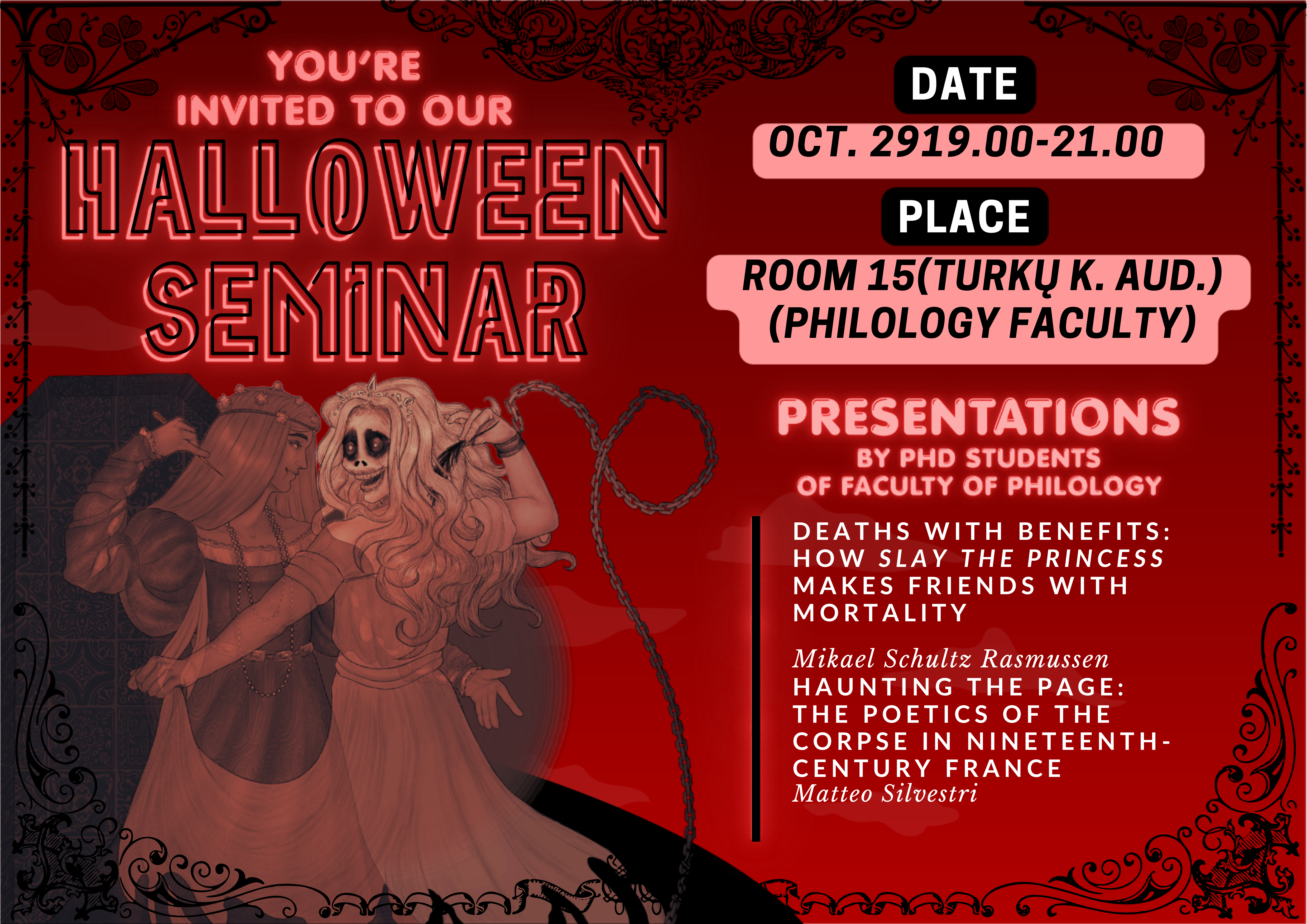
Šiurpnaktis jau čia pat! Tai puiki proga ne tik pasinerti į šiurpią Helovino atmosferą, bet ir pažvelgti į mirtį, vaiduoklius bei vampyrus iš akademinės perspektyvos.
Kviečiame į Vilniaus universiteto Filologijos fakulteto doktorantų seminarą, kuriame bus nagrinėjama, kaip mirtis, mirusiųjų kūnai ir pomirtinis gyvenimas vaizduojami šiuolaikiniuose vaizdo žaidimuose ir XIX a. prancūzų literatūroje.
Spalio 29 d. 19 val.
Turkų k. auditorijoje (tvarkaraštyje – 15, ant durų – 112)
Daugiau informacijos apie pranešimus anglų kalba žemiau.
[English]
Halloween is just around the corner! It’s the perfect opportunity not only to immerse yourself in the spooky Halloween atmosphere, but also to explore death, ghosts, and vampires from an academic perspective.
Join us for a seminar featuring doctoral students from Vilnius University’s Faculty of Philology, exploring how death, corpses, and the afterlife are portrayed in contemporary video games and nineteenth-century French literature.
October 29, 7 PM
Turkų k. Room (15 on the timetable, Room 112 on the door)
More about presentations:
- Mikael Schultz Rasmussen: Deaths with Benefits: How Slay the Princess Makes Friends with Mortality
Slay the Princess (Black Tabby Games, 2023) is a video game in which dying is never the end. Death changes characters, relationships, memories, environments, and the possibilities that follow, gradually transforming what first looks like a simple story about killing one princess into a much larger question: should death itself continue to exist? Drawing on posthumanist approaches to mortality and Braidotti's (2013) idea of “making friends with death,” this talk explores how Slay the Princess repeatedly presents death not simply as loss or failure, but as part of an ongoing process of change. I argue that the game ultimately privileges the Shifting Mound’s world of mortality, relation, and transformation over the Echo’s dream of permanent, deathless existence. Through recursive deaths, shifting identities, and contrasting visions of eternity, Slay the Princess suggests that endings need not be the opposite of continuation. Sometimes, what allows life to go on is precisely that things are allowed to end.
- Matteo Silvestri: Haunting the Page: The Poetics of the Corpse in Nineteenth-Century France
In nineteenth-century France, the human corpse occupied a deeply ambiguous space at the intersection of medical positivism, public fascination, and literary imagination (Ariès, 1977). To mark Halloween through the lens of Death Studies, this presentation explores how the dead body haunts the literary page, shifting between spectral obsession and vampires (Praz, 1933). Rather than treating ghosts and vampires as mere Gothic tropes, this talk examines them as critical thanatological tools to show how 19th century literature perceived mortality, decay, beauty and eroticism.
The discussion opens with Émile Zola’s Thérèse Raquin (1867), analysing how the unburied ghost of Camille haunts the narrative not as a traditional apparition, but as a decaying physical presence that disrupts the eroticism of the living. This spectral obsession is contextualised alongside the realistic, institutionalised depiction of the Paris Morgue (Downing, 2003) — a site where the corpse becomes a public spectacle, an object of scientific control, and a mirror of social voyeurism.Moving from the ghost and the clinical reality to the aestheticized boundary between death and desire, the second part explores the vampire of Théophile Gautier’s La Morte Amoureuse (1836). Here, the figure of the vampiric Clarimonde resists natural decomposition through poetic idealisation, serving as a literary defence mechanism against the horrors of physical dissolution (Bronfen, 1992). By juxtaposing Zola’s institutionalised death with Gautier’s erotically preserved corpse, this talk highlights how 19th century French literature navigates the delicate boundary between horror, beauty and eroticism when death comes into play.